
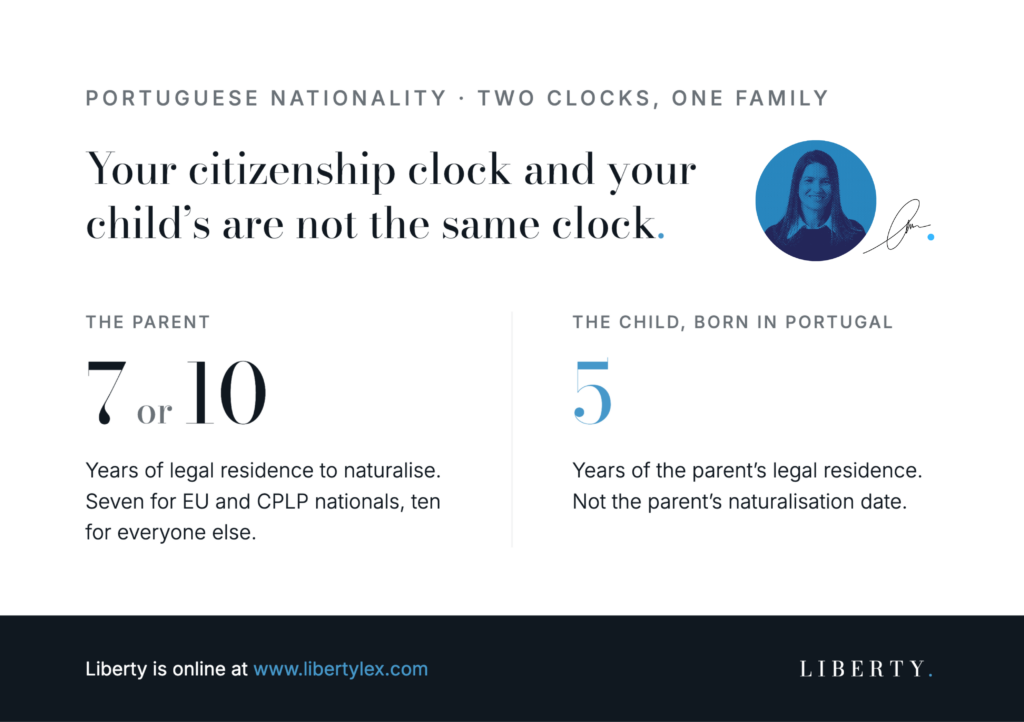
Under the 2026 Portuguese nationality law, a child born in Portugal to foreign parents can apply for Portuguese citizenship once one parent has five years of legal residence, while that parent still needs seven or ten. Since the reform came into force on 19 May 2026, this is the question investor families ask us most. Their own clock is now seven or ten years, and they want to know whether their children face the same wait.
The answer depends on where the child was born. For a child born in Portugal, the law keeps two routes that open on a five-year parental clock, and neither requires the parent to become Portuguese first. A child born abroad has no independent route: the child follows the parent, or waits for adulthood and runs a clock of their own. This article explains the three routes, what changed in May and the mistakes we see most often.
The parent’s clock: Portugal citizenship requirements of 7 or 10 years
Adult naturalisation runs under article 6.º, n.º 1 of the Nationality Law. Paragraph a) requires the applicant to be of age. Paragraph b) requires legal residence “for at least 7 years” for nationals of Portuguese-speaking countries and EU citizens, “or 10 years, in case of nationals of other countries”. For investors from the United States, Canada or the United Kingdom, the clock is ten years. Our article of 5 October covers that rule in detail.
The point for families: paragraph a) closes naturalisation under n.º 1 to minors altogether. Children need one of the routes below.
Route one: Portuguese citizenship by birth (article 1.º, n.º 1, f) of the Nationality Law)
The first route is original nationality. Article 1.º, n.º 1, paragraph f) attributes Portuguese nationality to “individuals born in Portuguese territory, who are children of foreign nationals that are not in the service of their relevant countries, who declare that want to be Portuguese, provided that, in the moment of the birth at least one of the parents is a legal resident in Portugal for at least 5 years”.
Three conditions apply:
- The child is born in Portugal.
- One parent already holds five years of legal residence on the day of birth.
- The family files a declaration. Nationality by birth is now an opt-in.
Before 19 May, paragraph f) worked the other way round. The child was Portuguese unless the parents declared otherwise, and one year of residence, “irrespectively of the title”, was enough. The reform multiplied the time requirement by five, demanded legal residence and reversed the default.
Route two: naturalisation of a minor born in Portugal (article 6.º, n.º 2)
The second route serves children born in Portugal before either parent reached five years. Under article 6.º, n.º 2, “The government grants citizenship to minors born on Portuguese territory, who are the children of foreign nationals, provided that, at the time the application is submitted, all of the following requirements are met”:
- at least one parent “has been legally residing in the country for at least five years”;
- the child “is enrolled in and regularly attending compulsory schooling, where applicable”;
- if the child has reached the age of criminal responsibility (sixteen, under article 19.º of the Penal Code), the child meets paragraphs e) to h) of article 6.º, n.º 1: the declaration of adherence to the democratic State of Law and the absence of relevant convictions, security concerns or UN and EU restrictive measures.
Three details of this route deserve a closer read. First, the parent’s five years are counted at the date of the child’s application, so a child born in year two of the parent’s residence qualifies in year five. Second, the verb is “concede” (grants): once every requirement is met, the Government grants citizenship, with no room for discretion. Third, the republished text refers a sixteen-year-old only to paragraphs e) to h). The language and culture test of paragraph c), now evidenced “through a test or a certificate”, and the rights-and-duties requirement of paragraph d) fall outside that reference.
This route has tightened too. Under the 2020 wording, the conditions were alternatives: a parent with five years of residence regardless of title, a parent with any legal residence, or a child with one year of pre-school or school. They are now cumulative, and the residence must be legal. Article 5.º of Lei Orgânica n.º 1/2026 of 18 May also revoked the former n.º 5, which let a person born in Portugal naturalise after five years of residence without a title.
Children born abroad: following the parent under Portuguese nationality law (article 2.º)
A child born outside Portugal has no five-year route. Article 2.º provides that “Minor or incapacitated children of a parent who acquires Portuguese nationality may also acquire it by means of a declaration”. The sequence is fixed: the parent naturalises first, under the seven or ten-year rule, and the children follow by declaration while they are still minors. The alternative is to wait for adulthood and run a clock of their own under n.º 1. The only other route, article 6.º, n.º 4, concerns minors in institutional care and does not apply to a family planning its future.
The declaration is where many families are caught out. Article 2.º is an acquisition “by an act of will”, and the Public Prosecutor’s Office (Ministério Público) can oppose every acquisition of that kind. The first ground for opposition, article 9.º, n.º 1, paragraph a), is “the absence of meaningful ties to the national community”. The 2026 text now assesses those ties “taking into account the material parameters set forth in paragraphs c) through i) of Article 6º, n.º 1”: knowledge of the language, culture, history and national symbols, knowledge of fundamental rights and duties, and the rest of the adult list. Under article 10.º, n.º 1, the Ministério Público has two years from the registration of the acquisition to bring an opposition action.
How the parent’s five years are counted: Golden Visa, D7, D8 and other titles
Both routes turn on the same phrase, “legally resides”. Article 15.º, n.º 1 treats as legally resident “the individuals present here, whose status has been regularized with the Portuguese authorities”, under any title, visa or authorisation of the immigration regime. A Portugal Golden Visa, a D7 visa, a D8 visa or a work permit all count toward Portugal residency for this purpose. Article 15.º, n.º 3 allows periods of legal residence, consecutive or interrupted, to be added up within a maximum span of nine or twelve years.
Waiting time no longer counts. Article 5.º of the Lei Orgânica revoked the former n.º 4 of article 15.º, under which the clock ran from the request for a temporary residence permit. For applications filed since 19 May 2026, the parent’s five years start with the issuance of the first visa or residence title. Every month spent waiting for AIMA to issue it is lost to the child’s file as much as to the parent’s. Our firm’s position is that time accrued under the former n.º 4 before 19 May survives, but that remains an argument: nothing in the published text settles it.
One transitional rule is settled. Article 7.º, n.º 2 of the Lei Orgânica applies the previous wording to “pending administrative proceedings” submitted before 19 May 2026. A child’s file submitted to the IRN before that date is examined under the old conditions.
What your family can do now
If your child was born in Portugal before 19 May 2026 and was never registered as Portuguese, file the registration now.
For every other family, four steps help you plan the timeline:
- Identify which parent reaches five years of legal residence first, and on what date.
- Keep that parent’s title history complete, including the periods article 15.º, n.º 3 allows to be joined.
- If a child is born in Portugal before that date, mark the fifth anniversary of that parent’s first visa or residence permit: the n.º 2 route opens then.
- If a child was born in Portugal before 19 May 2026, have the file assessed under both the former and the current wording before filing.
One practical note: the ninety-day deadline to revise the Regulamento da Nacionalidade (article 6.º of the Lei Orgânica) expired in August with no new regulation published, so the registry still works under the 2006 regulation.
Portuguese nationality law: frequently asked questions
Is a child born in Portugal automatically Portuguese?
Since 19 May 2026, no child of foreign parents becomes Portuguese automatically at birth. Portuguese citizenship by birth requires one parent with five years of legal residence on the day of birth and a declaration filed by the family.
What changed in the new Portuguese citizenship law for children?
The parental residence requirement for nationality by birth rose from one year to five, residence must now be legal, and the default reversed to an opt-in. For minors born in Portugal who naturalise, the parent’s five years and the child’s school attendance are now cumulative conditions.
Can my child get Portuguese citizenship before I do?
Yes, if the child was born in Portugal. Both routes for children born in Portugal open on one parent’s five years of legal residence, while the parent’s own naturalisation requires seven or ten years. A child born abroad follows the parent.
Does a Portugal Golden Visa count toward my child’s five years?
Yes. Article 15.º counts any title, visa or authorisation of the immigration regime, including the Golden Visa, the D7 and the D8. The clock starts on the issuance of the first visa or title for applications filed since 19 May 2026.
What are the Portugal naturalization requirements for a 16-year-old born in Portugal?
One parent with five years of legal residence, enrolment and regular attendance in compulsory schooling, and the requirements of article 6.º, n.º 1, paragraphs e) to h). The language and culture test does not apply under this route.
Plan your family’s timeline under the Portuguese nationality law
A child who grows up in a Portuguese school should not have to wait for a parent’s tenth anniversary to belong. The 2026 Portuguese nationality law made the road harder, and it kept this route open. Families who understand the clock can plan around it.
Book a consultation with our team at libertylex.com to map your family’s residence and citizenship timeline.
This article provides general information on Portuguese nationality law as of 19 October 2026 and does not constitute legal advice. Requirements depend on each family’s circumstances and on the interpretation of the competent authorities. Consult a qualified lawyer before filing any application.