
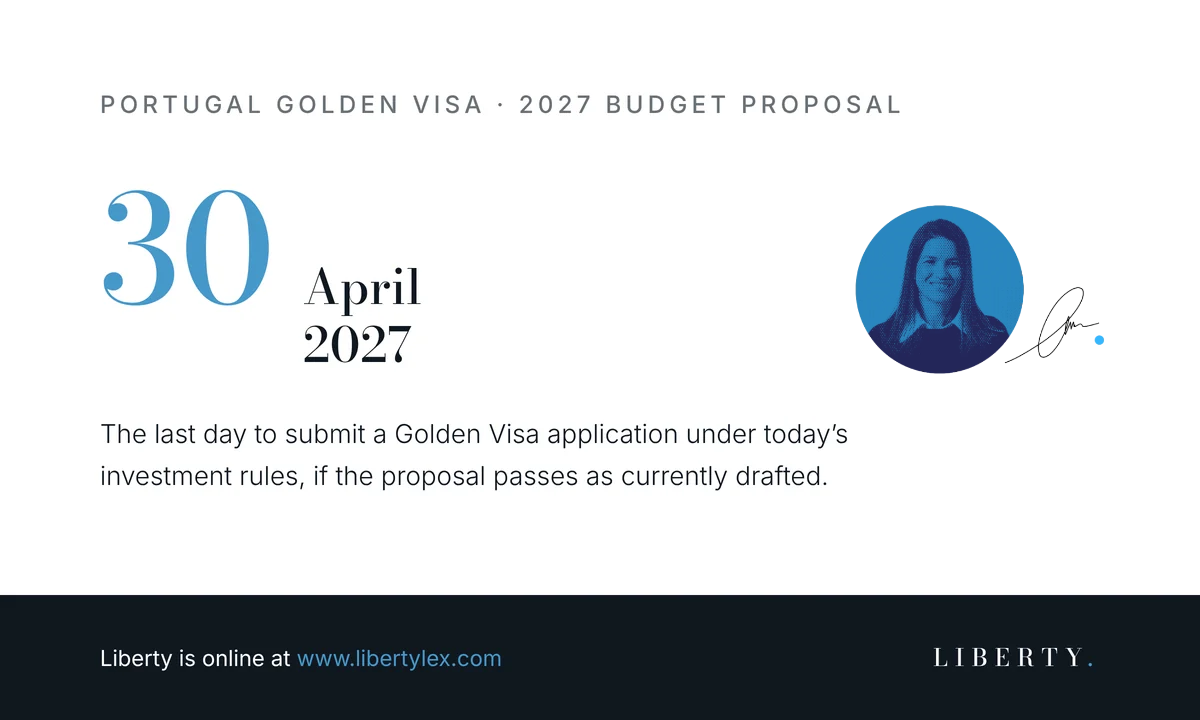
Portugal’s Parliament votes the 2027 State Budget on 24 November 2026. Inside it sits a proposal from PSD and CDS-PP that rewrites the list of investments that qualify for the Portugal Golden Visa. The version now on the table, a substitution text dated 13 November, applies these Portugal Golden Visa changes only to applications submitted after 1 May 2027.
Since the first version was tabled on 6 November, the question we hear most often from investors is a personal one: do these Portugal Golden Visa changes affect me? The answer depends on one date, the day your application is submitted to AIMA. This article walks through the four situations our investors are in.
The short answer: who the Portugal Golden Visa changes affect
For most investors who already hold a Golden Visa or have an application pending, no.
The proposal carries its own transitional clause, a new n.º 8 of article 138.º of the Budget law. In the first version, of 6 November, the new rules applied to applications submitted after the law entered into force, in practice 1 January 2027. The substitution text of 13 November moved the date: the changes «apenas se aplicam aos pedidos de ARI apresentados após 1 de maio de 2027», they apply only to ARI applications submitted after 1 May 2027.
Nobody needs to act before January. The investors who need to plan are those who have invested, or are about to invest, and have not yet filed. For them, the submission date on AIMA’s portal decides which set of rules applies, and the line is now drawn at the end of April.
Portugal Golden Visa changes: what the proposal rewrites
The amendment inserts an article 135.º-A into the Budget bill (Proposta de Lei n.º 110/XVII/2.ª) and rewrites four points of article 3.º, n.º 1, d) of Lei n.º 23/2007, the provision that lists what counts as an investment activity for an autorização de residência para atividade de investimento (ARI). The description below follows the substitution text of 13 November, signed by 22 deputies of the two groups, which replaces the version of 6 November.
The Golden Visa fund route: from 60% to 70% in capital or quasi-capital
The fund route, subalínea vii), keeps its €500,000 minimum, its ban on real-estate funds and its five-year maturity. What changes is the test applied to the fund’s portfolio.
| Current rule | First version (6 Nov) | Substitution text (13 Nov) | |
|---|---|---|---|
| Share invested in Portuguese companies | At least 60% | At least 80% | At least 70% |
| How the exposure must be acquired | Companies with their seat in Portugal | Share capital only | Capital or quasi-capital |
| Purpose of the fund | Not specified | Capitalisation of companies | Capitalisation of companies |
The new text requires the fund to be «vocacionado para a capitalização de empresas», a fund whose purpose is to capitalise companies, and requires that at least 70% of its investments be made «através de reforço de capital ou quase-capital de sociedades comerciais sediadas em território nacional», through capital or quasi-capital in Portuguese companies.
In Portuguese fund practice, quasi-capital covers instruments such as shareholder loans and convertible bonds that managers use alongside equity. Buying existing shares from another investor, or holding listed shares of Portuguese companies, would still not count towards the threshold. The explanatory note says the aim is that fund money «se traduza no efetivo reforço de capital ou quase-capital» of Portuguese firms.
Research route: down to €250,000
The research route, subalínea v), falls from €500,000 to €250,000 for capital applied in research activities of public or private institutions integrated in the national scientific and technological system. The explanatory note says this aligns research with the cultural route.
Cultural route: open to more recipients
The cultural route, subalínea vi), stays at €250,000. Its list of eligible recipients now adds «associações privadas com fins altruísticos e estatuto de utilidade pública», private non-profit associations with public-utility status, alongside the public bodies, foundations and cultural associations already there.
A new social route at €250,000
A new subalínea ix) admits €250,000 or more applied in building or restoring social care facilities for children, young people, the elderly or people with disabilities, or facilities for the integration of foreign residents and beneficiaries of international protection.
The money must go through a closed list of recipients: State services, public institutes, public foundations, private foundations, cooperatives, mutual associations, misericórdias and private social solidarity institutions with public-utility status, and intermunicipal and municipal entities with responsibilities in those areas. Article 3.º, n.º 4, the clause that requires a review every two years, is extended to the new route.
What stays the same
Job creation, the company route and the minimum amounts of the other routes keep their current text. Article 90.º-A, which governs the permit itself, its two-year validity and its renewal, is untouched, as are the fees in Portaria n.º 307/2023 and the minimum stay of seven and fourteen days.
Situation one: you already hold a Golden Visa
Your application was submitted and decided under the current article 3.º. At renewal, article 90.º-A checks whether the investment you declared at the time has been maintained for the statutory period, and the proposal leaves that yardstick unchanged.
On the text as tabled, a holder whose fund met the 60% test when the application went in keeps that test at Portugal Golden Visa renewal, and will not be asked to show that the fund has moved to 70% in capital or quasi-capital. This is our reading of article 138.º, n.º 8, and it is also the reading that legitimate expectations require.
Because the clause speaks of «pedidos» and a renewal is also, loosely, a request, we will ask AIMA to confirm this in writing once the law is published. We have also said publicly that Parliament could remove the doubt with a single line on renewals.
Situation two: your application is pending at AIMA
The same clause protects you. Roughly 46,000 initial ARI applications were pending in October, according to the Minister of the Presidency’s hearing of 7 October 2026, some of them since 2021.
Each of them was submitted before the new law, each is assessed against the list in force at submission, and nothing in the proposal reopens them. A long wait for a decision keeps an application in the regime it was filed under, and the Government told Parliament on 3 November that these files would be a priority in 2027.
Situation three: you have invested but have not filed
This is the group the clause leaves exposed, and the group with a decision to make between now and the end of April.
If you have subscribed a fund, or are completing a capital transfer, and the application has not yet been submitted on AIMA’s portal, the date of that submission is the only thing that fixes your rules. The same investor, with the same fund, filing on 30 April 2027 is assessed under the 60% test. Filing on 2 May, the same file meets the 70% capital-or-quasi-capital test and the requirement that the fund be «vocacionado para a capitalização de empresas». If the fund fails the new test, the application fails on the investment requirement, however sound the fund.
The move from 1 January to 1 May gives this group four more months than the first version did, and gives fund managers the same four months to adjust their investment policies. We had argued for exactly that kind of transition period, and it is right to say so.
Three practical steps follow:
- Ask the fund manager, in writing, what share of the portfolio is invested through capital or quasi-capital in Portuguese companies, and whether the fund intends to meet the 70% test and to describe itself as a fund for the capitalisation of companies. A prospectus that speaks of «sociedades sediadas em Portugal» without saying how the exposure is acquired leaves the question open.
- If the answer is uncertain and your file is otherwise complete, submit before 1 May 2027. That step keeps today’s rules, and the portal records the date.
- Watch the open points. The proposal still does not say when the 70% is measured (at subscription, at renewal or continuously), nor how a fund still in its investment period is assessed. Adding quasi-capital answered one of the questions we raised about the first version; the others remain for the committee stage. Until they close, an investor who files after April is pricing a text that is still moving.
Situation four: you are planning to apply in 2027
If you file after 1 May 2027, you will apply under the new list, if it passes. In practice that means:
- a fund route tied more closely to private equity and venture capital in Portuguese companies;
- a research route at half its current cost;
- a cultural route open to more recipients;
- a social route that is, on its face, a donation of €250,000 to an accredited institution.
The research and social routes are, in our view, sensible additions. Whether they attract investment will depend on whether the receiving institutions are ready with the documentation AIMA will ask for. The fund route is the one to watch, because its qualification will depend on the manager’s portfolio decisions after you have subscribed.
How the vote works: key dates
- 28 October 2026: the Budget passed the general vote with PSD and CDS-PP in favour and PS, PAN and JPP abstaining.
- 6 November: first version of the Golden Visa amendment tabled.
- 13 November: substitution text tabled (70% test, 1 May 2027 cut-off).
- 18 November: detailed votes in the budget committee begin.
- 24 November: final global vote, then promulgation by the President.
- December 2026 / 1 January 2027: recent budget laws have been published in December and entered into force on 1 January.
- 1 May 2027: under the substitution text, the new Golden Visa rules apply to applications submitted after this date.
A proposal of the two Government parties passes if PS abstains, whatever Chega does, and the opposition’s own budget proposals on Golden Visas ask for more conditions rather than fewer. The text was already rewritten once between 6 and 13 November and can be rewritten again before 24 November. The figures above describe a proposal; they become law only after the final vote and publication.
Four mistakes to avoid
- Treating the investment date as the date that counts. The clause turns on the submission of the application: an April subscription with a May filing is a May filing.
- Assuming a fund that qualifies today will qualify in May. That is the manager’s decision, and you want it in writing.
- Reading the 70% as a renewal requirement for existing holders. The transitional clause says otherwise, and we would resist any reading that applied it to permits already granted.
- Reading 1 May as a distant date. The vote is on 24 November, the documents for a complete file take months for most families, and the date that counts is the one AIMA’s portal records, whatever day the file was ready.
Portugal Golden Visa changes: frequently asked questions
Are the Portugal Golden Visa changes already law?
No. They are an amendment to the 2027 State Budget bill. The final vote is on 24 November 2026, and the text can still change before then.
Is the Portugal Golden Visa ending?
No. The proposal changes which investments qualify and adds two €250,000 options (research at a lower threshold and a new social route). The programme stays open.
Will the new fund rules apply to my Golden Visa renewal?
On the text as tabled, no. Renewal checks the investment against the rules in force when your application was submitted. We will ask AIMA to confirm this in writing once the law is published.
Which date decides whether the old or new rules apply to me?
The date your application is submitted on AIMA’s portal. The date you invested in the fund does not decide it.
What to do about the Portugal Golden Visa changes now
Identify which of the four situations you are in. If it is the third, get the fund manager’s written position now and plan your submission well inside April. If it is the first or second, keep the record of your original investment and your submission date together: that pair of documents is what article 138.º, n.º 8 protects.
We will publish the final text as voted on 24 November, along with any further change to the percentage or the date.
Talk to our Golden Visa lawyers about your investment and filing date. Book a review with the Liberty team and find out how the proposed article 3.º applies to your case.